


Tennessee has long relied on radar, satellite estimates and scattered weather stations to monitor conditions. That approach is about to change with the construction of a Mesonet — a network of 95 weather stations, one in each county, designed to capture weather on a much smaller scale.
Andrew Joyner, the Tennessee state climatologist and a professor at East Tennessee State University, says the more detailed data will help users make better decisions.
“That’s really important. Say you're a farmer and you want to spray pesticide, if you have a temperature inversion and you spray, then it's going to drift to the wrong field,” Joyner said.
Each Mesonet station will include a 33-foot tower equipped with sensors that measure temperature, rainfall, wind and humidity. Instruments buried underground will track soil moisture and soil temperature — an area where data has historically been limited, especially during droughts.

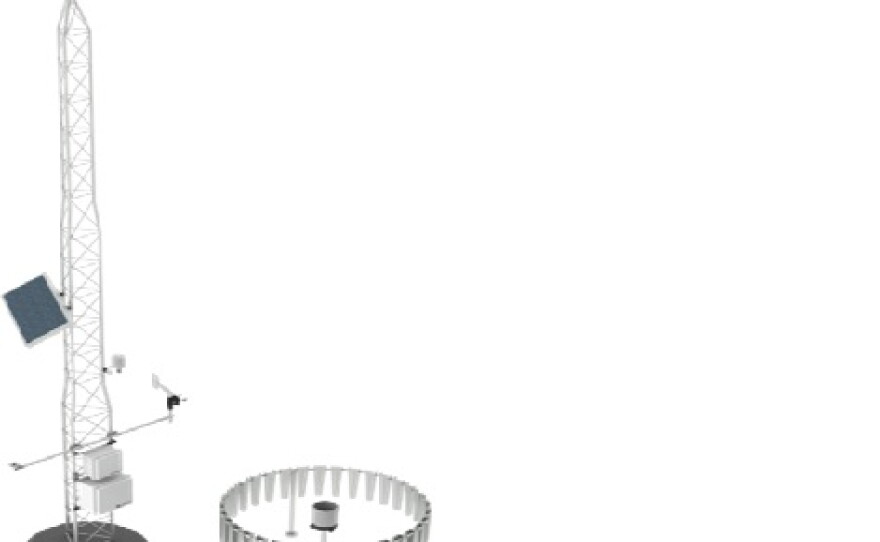
“So there'll be soil moisture sensors and soil temperature sensors at five different levels. So two inches, four inches, eight inches, 20 inches and 40 inches. That's an area that we're really kind of blind to at the moment,” Joyner said.
Stations will collect data every five minutes and even more frequently during severe weather. That level of precision could significantly improve flood warnings.
Joyner pointed to the deadly 2021 Waverly flood in Middle Tennessee, when more than 20 inches of rain fell in less than a day.
“We didn't know that until a month later, you know, because we were digging through all these archives of data and everything else, and we would know that instantly,” he said.
Emergency managers say having immediate access to that information could save lives.
Sarah DeLozier, an operations officer with Knox County Emergency Management, says real-time data helps agencies respond more effectively after disasters.
“After something bad happens, our jobs are to go in and assess the damage so that we can request support if we need to, and of course, to get the community back up and running,” DeLozier said.
She says the Mesonet will also help emergency managers prepare, even on calm days.
“We're all excited to be able to aggregate that data and use it to track storm system patterns, and hopefully be able to more accurately predict exactly what's going to happen for one area or another,” DeLozier said.
That local focus is especially important in East Tennessee, where terrain can cause conditions to vary dramatically within just a few miles.
“There are people who live in all different types of terrain throughout the county. So in one area there might be a tornado, and in the other area, it might be completely blue skies and very slow wind,” DeLozier said.
Tennessee Emergency Management meteorologist Megan Schargorodski says the Mesonet will benefit nearly every industry, with public safety at the top of the list.
“Virtually any sector that you can think of can benefit from a State Mesonet. The first and most critical is public safety,” Schargorodski said.

Schargorodski previously worked with the Kentucky Mesonet and is now using that experience to help Tennessee become the 42nd state to operate one. She says being late to build a Mesonet has allowed Tennessee to learn from other states and design a system built for the future.
“Having virtually nothing across the state, and being able to have those 95 stations will be so huge, and it'll make such a big difference,” she said.
Lawmakers have allocated $3 million to build the network. Construction on some sites could begin as early as this spring, with at least half of the stations operational by the end of the year.
For Joyner, the project has been years in the making.
“It’s taken us a long time, and really, unfortunately, some of these catastrophic events that highlight the need for this type of information,” he said.
Once complete, the data will be publicly available online, allowing anyone — from farmers to first responders — to see conditions across the state in real time. After each county has a station, they will assess where extra stations are necessary due to terrain variations.
